
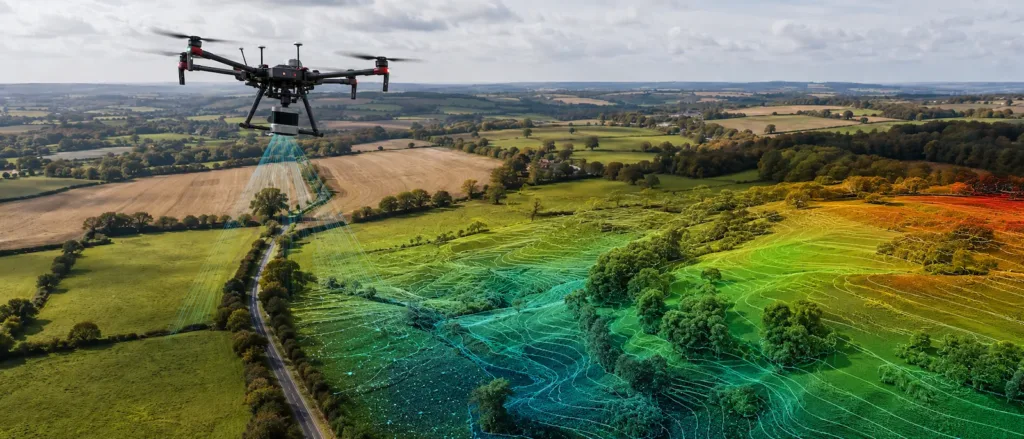
Aerial LiDAR surveys use laser-scanning equipment mounted on a drone or other aircraft to capture accurate three-dimensional information about terrain, buildings, vegetation and other surface features.
The resulting point cloud can be processed into topographical survey information, terrain models, contours, volume calculations and other mapping outputs.
This guide explains how aerial LiDAR surveys work, their main advantages and limitations, the types of data they produce and the projects they are best suited to.
What Is Aerial LiDAR Surveying?
Aerial LiDAR surveying is a form of remote surveying in which a laser scanner is carried above the ground by an aircraft. For many local and medium-sized projects, the sensor is mounted on an unmanned aerial vehicle, commonly referred to as a drone.
LiDAR stands for Light Detection and Ranging. The system sends rapid laser pulses towards the ground and measures how long each pulse takes to return after reflecting from a surface.
By combining these distance measurements with accurate positioning and orientation data, the system calculates the three-dimensional position of millions of points across the survey area.
The resulting dataset is known as a point cloud. Each point represents a measured position on the ground, vegetation, a structure or another visible surface.
How Aerial LiDAR Surveys Work
An aerial LiDAR system normally combines several pieces of equipment:
- A laser scanner
- A drone or other aerial platform
- A Global Navigation Satellite System receiver
- An inertial measurement unit
- On-board data storage
- Ground control or survey check points where required
The laser scanner measures the distance between the sensor and the surfaces below. The positioning system records the aircraft’s location, while the inertial measurement unit records its movement and orientation.
These measurements are combined during processing to calculate the position of each LiDAR point.
1. Survey Planning
Before flying, the survey team reviews the site, required outputs, ground conditions, airspace restrictions and access arrangements.
The flight plan is designed around factors such as:
- The size and shape of the survey area
- The required point density
- The flying height
- The terrain and vegetation
- Nearby buildings and obstacles
- The required accuracy
- Local flight restrictions
- Weather and visibility
The required coverage and overlap are then established so that the survey area is recorded consistently.
2. Establishing Survey Control
Depending on the project specification, survey control points or independent check points may be established on the ground.
These points provide a known reference for checking the position and height of the aerial survey data. They can also help align the completed dataset with the required project coordinate system.
3. Flying the Survey
The drone follows the planned flight lines while the LiDAR sensor records the area below.
The scanner emits many laser pulses as the aircraft moves. Some pulses may return from roofs, vegetation, roads or other surface features, while others may pass through gaps in vegetation and reach the ground.
This ability to collect multiple returns can make aerial LiDAR surveys particularly useful where the ground is partly obscured by trees or other vegetation.
4. Processing the Data
After the flight, the LiDAR observations, positioning data and orientation information are processed together.
The resulting point cloud is checked for completeness, alignment and consistency. Survey control and independent check points can then be used to assess the finished dataset against known positions.
The point cloud may also be classified into groups such as:
- Ground
- Vegetation
- Buildings
- Roads and hard surfaces
- Structures
- Unclassified points
Further survey drawings and models can then be produced from the processed information.
What Can Aerial LiDAR Surveys Measure?
Aerial LiDAR surveys can record a wide range of visible terrain and surface features.
Depending on the project scope and site conditions, these may include:
- Ground levels
- Changes in terrain
- Embankments and cuttings
- Roads and tracks
- Buildings and roof structures
- Walls and fences
- Vegetation height and canopy structure
- Quarries and stockpiles
- River corridors and floodplains
- Visible utilities and infrastructure
The ability to identify ground beneath vegetation depends on the density and type of vegetation, the season, the survey geometry and the specification of the LiDAR system.
Typical Aerial LiDAR Survey Outputs
The point cloud is normally the primary measured dataset, but it can be processed into several additional outputs.
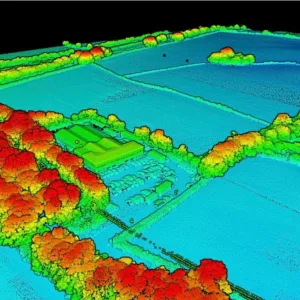
Colourised aerial LiDAR point cloud showing buildings, vegetation and surrounding terrain.
Classified Point Cloud Data
A classified point cloud separates measured points into categories such as ground, vegetation and buildings.
This allows clients and designers to isolate particular features or analyse different parts of the surveyed environment.
Digital Terrain Models
A digital terrain model represents the ground surface after features such as buildings and vegetation have been removed from the dataset.
It may be used for:
- Contour generation
- Drainage assessment
- Earthworks design
- Flood modelling
- Route planning
- Terrain analysis
Digital Surface Models
A digital surface model records the upper visible surface of the surveyed area. This can include buildings, trees, vegetation and other objects above the ground.
Surface models can support visualisation, height analysis, planning and environmental assessment.
Topographical Survey Drawings
LiDAR data can be used alongside ground survey information to produce topographical survey drawings.
These drawings may include contours, levels, buildings, visible boundaries, roads, structures and other agreed features.
Aerial data does not automatically replace ground-based surveying. Features hidden beneath tree cover, vehicles, structures or other obstructions may still need to be measured from the ground.
Contours and Level Information
Contours can be generated from the classified terrain model to show changes in ground height across the survey area.
The contour interval should be appropriate for the survey accuracy, terrain and intended use of the data.
Volume Calculations
Aerial LiDAR surveys can be used to calculate volumes for stockpiles, quarries, earthworks and other areas where the surface geometry is visible from the air.
Repeat surveys can also be compared to assess how volumes or ground surfaces have changed over time.
Benefits of Aerial LiDAR Surveys
Efficient Coverage of Large Areas
A drone-mounted LiDAR system can collect survey information across a larger area more quickly than many ground-based methods.
This can be particularly valuable where the project site is extensive or difficult to traverse on foot.
Surveying Difficult Terrain
Aerial LiDAR surveys can reduce the need for surveyors to walk across steep, unstable, heavily vegetated or otherwise difficult ground.
This can improve safety and make it practical to record areas that would be slow or difficult to survey solely from ground level.
Dense Three-Dimensional Data
The survey produces a dense three-dimensional record rather than a limited number of individually observed points.
This provides useful source information for terrain modelling, engineering design, planning and environmental analysis.
Vegetation Penetration
Some LiDAR pulses can pass through gaps in vegetation and return from the ground below.
This does not mean that LiDAR sees directly through solid vegetation. However, it can provide more ground information beneath trees and scrub than conventional aerial photography in suitable conditions.
Repeatable Monitoring
Sites can be surveyed again using a similar flight plan so that changes can be compared over time.
This may be useful for:
- Earthworks monitoring
- Stockpile measurement
- Erosion assessment
- Vegetation management
- Quarry monitoring
- Construction progress
Limitations of Aerial LiDAR Surveys
Aerial LiDAR is a powerful surveying method, but it is not suitable for every requirement.
Obstructed Features
The system can only measure surfaces reached by the laser pulses.
Features beneath solid roofs, inside buildings, under parked vehicles or completely hidden by dense vegetation will not be recorded reliably from the air.
Weather Restrictions
Strong wind, rain, poor visibility and other unsuitable conditions can prevent or delay drone operations.
Wet surfaces and standing water may also affect the quality or completeness of some returns.
Airspace and Site Restrictions
Drone flights must be planned around applicable aviation requirements, restricted airspace, nearby airports, people, roads and other site-specific hazards.
Some locations may require additional permissions, coordination or alternative survey methods.
Drone surveys must be planned and operated in accordance with current UK aviation requirements. The UK Civil Aviation Authority’s drone regulatory framework provides official guidance on the rules that apply to unmanned aircraft operations.
Ground Detail
Small features, vertical surfaces and objects hidden beneath overhangs may not be captured as completely as they would be during a detailed ground survey.
For this reason, aerial LiDAR surveys are often combined with total station, GNSS or terrestrial laser-scanning observations.
Common Applications of Aerial LiDAR Surveys
Topographical Mapping
Aerial LiDAR surveys can provide terrain and surface information for planning, engineering, development and infrastructure projects.
Forestry and Vegetation Surveys
The data can be used to assess canopy height, vegetation structure, woodland coverage and the relationship between trees and the ground surface.
Flood-Risk and Drainage Studies
Detailed terrain information can support hydraulic modelling, floodplain analysis and drainage design.
Road, Rail and Utility Corridors
Linear infrastructure routes can be surveyed to record surrounding terrain, cuttings, embankments, vegetation and visible structures.
Quarries, Stockpiles and Earthworks
Surface models can be used to calculate volumes and monitor changes across working sites.
Heritage and Archaeology
Terrain models can help reveal subtle landscape features that may be difficult to recognise at ground level or in conventional aerial imagery.
Environmental Monitoring
Repeat aerial LiDAR surveys can support the assessment of erosion, land movement, vegetation change and other environmental processes.
How Accurate Are Aerial LiDAR Surveys?
There is no single accuracy figure that applies to every aerial LiDAR survey.
The achieved accuracy depends on several factors, including:
- The LiDAR sensor
- The flying height
- The flight speed
- The quality of the positioning solution
- The survey-control arrangement
- The terrain and vegetation
- The processing method
- The required point density
- Weather and site conditions
The required accuracy should be agreed before the survey is planned. The survey specification should also state how the completed data will be checked and reported.
Claims that aerial LiDAR always achieves one fixed accuracy should be treated cautiously. A suitable method must be selected for the scale and purpose of each project.
Aerial LiDAR Compared with Drone Photogrammetry
Aerial LiDAR and drone photogrammetry both produce three-dimensional survey information, but they collect data differently.
Photogrammetry uses overlapping photographs to calculate surface geometry. It can produce detailed colour imagery and textured models where surfaces are clearly visible.
LiDAR measures distance directly using laser pulses. It can be particularly useful where terrain is partly covered by vegetation or where a dense set of three-dimensional measurements is required.
The better method depends on the site, the required outputs and the survey specification. Some projects benefit from combining both technologies.
When Is Ground Surveying Still Required?
Ground observations may still be needed where:
- Important features are hidden from the air
- Precise boundary positions are required
- Drainage covers or service details must be recorded
- Vertical building faces require more detail
- Dense vegetation prevents sufficient ground returns
- The project needs independent checks
- Specific features require direct identification on site
A combined aerial and ground-survey approach often provides the most complete result.
How Much Do Aerial LiDAR Surveys Cost?
The cost of an aerial LiDAR survey depends on the scope and complexity of the project.
Factors affecting the fee may include:
- The survey area
- The required accuracy
- The required point density
- The terrain and vegetation
- The site location
- Airspace restrictions
- The amount of ground control required
- The required drawings and models
- The coordinate system
- Access and operational restrictions
- The required delivery programme
Providing a clear project boundary, site location and list of required outputs will help the survey company prepare an accurate quotation.
What Information Is Needed for a Quotation?
When requesting a quotation, it is helpful to provide:
- The site address or location
- A marked survey boundary
- The approximate area
- The intended use of the data
- The required accuracy
- The required file formats
- The coordinate and level datum
- Any required drawings or models
- The required completion date
- Known access or flight restrictions
A clear brief allows the survey method, flight plan and deliverables to be designed around the project requirements.
Frequently Asked Questions About Aerial LiDAR Surveys
Can aerial LiDAR survey ground beneath trees?
It can record some ground points through gaps in vegetation. The amount of usable ground data depends on the density and type of vegetation, the season, the survey geometry and the LiDAR system.
Can aerial LiDAR survey buildings?
Yes. It can record roofs, visible facades and surrounding terrain. Areas hidden beneath overhangs or not visible from the flight path may require terrestrial scanning or other ground observations.
Can aerial LiDAR operate in all weather?
No. Drone operations are affected by wind, rain, visibility and other site conditions. Flights must only proceed when conditions are safe and suitable for the required data quality.
Is aerial LiDAR suitable for small sites?
It can be, but the setup and processing requirements may mean that a ground-based survey is more efficient for some small or simple sites.
Can aerial LiDAR be used for repeat monitoring?
Yes. Repeat surveys can be compared to identify changes in terrain, vegetation, stockpiles, earthworks and other visible surfaces.
Aerial LiDAR Surveys from Pinpoint Mapping
Pinpoint Mapping provides aerial LiDAR surveying and associated mapping services for projects across Bristol, Bath and the South West.
Depending on the survey brief, outputs may include:
- Registered LiDAR point clouds
- Classified point-cloud data
- Digital terrain models
- Digital surface models
- Contours and level information
- Topographical survey drawings
- Volume calculations
- Additional mapping outputs by agreement
Each project is assessed individually so that the survey method, accuracy and final deliverables are appropriate for the site and intended use.
Request an Aerial LiDAR Survey Quotation
To request a quotation, send us the site location, survey boundary, required outputs and any available project specification.
Contact Pinpoint Mapping by telephone or email, or use the Request a Quote form on our website. We will review the information and provide a quotation based on the required survey scope.